Got lots of lovely pictures of a kitchen garden looking good! I was very proud of this, because, as I mentioned, I had had no experience of food production in a professional capacity. I had grown a few bits at home, and I had even had an allotment once, but I didn't much like having to go elsewhere to find my garden. At home I like to see the garden out of the window. An allotment half a mile up the road was not a joy every time I looked outside. And frankly, that experience was inadequate for the standards of presentation I felt obliged to provide in a garden open to the public, albeit one which had hardly any visitors. Busy little Scottish tourist town, teeming with people all summer, and we were getting only 10,000 a year. We had to provide something better to bring them in, I feared. So the baldy old bloke got busy -
That was in my first April. All the rest of the kitchen garden was dug and manured where necessary. This was the final piece, a spare area next to the fruit cage, where I intended to grow some perennial edibles, such as Artichokes, Cardoons and Asparagus, some rhubarb and some useful comfrey.
By July, the same area looked like this -
Progress in the rest of the beds was rapid from planting or sowing to harvest, as most of the veggies do their stuff in one season. By June we also had the makings of a dried flower border in a relatively young state, although we would be harvesting some flowers in the first year from the stronger divisions -
The hedges were beginning to green up by now, and the fruit on the walls was looking better with leaves on to cover up their less than ideal shapes. As for vegetables, the early part of the season looked sparse, but promising. In the foreground the root crops were through the ground where we had sown seed, the potatoes to the right were lush and green, brassicas had been planted and the beans were just starting to move up their wigwams of bamboo canes -
The benefits of the shorter rows could be seen, and as you can observe, we tended to work from planks placed on the narrow pathways at this stage -
We were growing plenty of dwarf French Beans, purple, golden and green ones, as well as three different Runner Beans with white, red and bi-coloured flowers for ornament. We had space left over in that part of the rotation, and rather than give in to a surfeit of beans (we all know the consequences of that) I put part of the area down to Sweetcorn, planted in blocks, which ultimately were a success -
In the foreground we see part of the brassica plantings, with coir collars to keep the Cabbage Root Fly at bay organically. They are protected by netting to keep birds and Cabbage White butterflies off. All in all, my first attempt at this kind of gardening was looking very promising.
The rocky road to the success I used to be
I have now moved in a different direction with this blog, and am investigating the ideas which I developed in my career in horticulture. I shall entitle it 'The rocky road to the success I used to be'.
However, whilst doing that, let us not forget that this started out as a way of retaining my sanity while housebound for three years following an accident. I wrote the hilarious and deeply poignant story of my redemption in daily instalments of about a thousand words, for a period of nearly eighteen months. The first 117 chapters are now available as a Kindle book, readable on your Kindle device, your PC, iPad or Smartphone with an app. Please follow the link below to sample and purchase:
http://www.amazon.co.uk/Nil---mouth-Cancel-Cakes-ebook/dp/B00A2UYE0U/ref=sr_1_1?s=digital-text&ie=UTF8&qid=1352724569&sr=1-1
Also now published is Volume 2, 'A Long Three Months', comprising chapters 118-266.
http://www.amazon.co.uk/Three-Months-Cancel-Cakes-ebook/dp/B00CYNFTDE/ref=sr_1_1?s=digital-text&ie=UTF8&qid=1369413558&sr=1-1&keywords=A+long+three+months
And finally, Volume 3 is now available at the link below:
http://www.amazon.co.uk/Drawing-Close-Cancel-Cup-Cakes-ebook/dp/B00GXFRLE4/ref=sr_1_1?s=digital-text&ie=UTF8&qid=1385545574&sr=1-1&keywords=Drawing+to+a+Close
I have now removed all the original posts to make space for the future.
Thank you for reading. Having an audience is marvellous for focussing the mind. I am also working on some drawing projects which will take me away from the keyboard for a while, and I write other stuff too, which you can find popping up occasionally on my website https://nicolsonbrooks.com/. And I have my own little garden to look after. Keep looking in, though, as I have no idea what will land on the page, where it might come from, or when. You have all been invaluable to what has been produced so far.
Monday, 24 April 2017
Sunday, 23 April 2017
Day 97 - Location, location, location
Right. Let's start with another picture of the newly reshaped hedges, just to get us of to a positive start -
Now, that is irrelevant to what I am going to tell you about the vegetable garden, but it's a nice enough picture to get us going. Just to the left of it, behind a low wall is the food-growing area. Yesterday I showed you its layout as I took it over, and to begin with the main task was simply to dig it through and clear it of weeds. We also had to construct a decent fruit cage to replace the small makeshift wooden structure that existed before. Here is a photo of one of my new colleagues engaged in just some of the digging, with the part-completed cage behind him. As you can see, I had opted to take up one of the three rectangles for fruit, leaving the remaining two for vegetables, as we no longer needed to supply the same quantity for year-round use as we would in a lived-in house -
All that we still had to do on the fruit cage was to attach the bird-proof netting and it would be ready to plant.
As for the vegetables, in the remaining two rectangles I had a new layout in mind. Up to now it had looked very amateurish, with long rows leading towards the distant hills, which usually were trampled with scruffy footprints resulting from harvesting or weeding. Add in to that the general neglected look with vegetable debris discarded on the surface, and it looked like a poorly-maintained allotment belonging to a lazy gardener with no standards. My solution was to divide each rectangle into six sections, separated by five paths pointing in the same direction as the original rows of vegetables, i.e. towards the hills in the photo above. Then, working from these paths we could sow, plant, weed and harvest without stepping on the growing areas. How did we achieve this? By laying out the plants at right angles to the paths, or across the picture you see above rather than down its length. It was a bit of a stretch for the smaller guys, because the new beds were possibly as much as ten feet long, but as they could be accessed from paths at either end, that meant a five-foot reach was required, which was easily manageable with a hoe. It worked for me, and in the event, I was more involved with this area of the garden than my colleagues. Oh, while we are on the subject, if you want to be efficient, weeding should only ever be done standing up. Crawling about on your hands and knees is slow, dirty and less effective. My aim is always to work quickly, standing, come out backwards, and use your hoe or fork to remove all evidence that you have been there on your way out. I think I've discussed before how flexible a hoe can be if used imaginatively. Try and get all the roots out with it, knock them about a bit to shake the soil off , let the small annual ones die off in the sun, pick up the larger and perennial ones and remove them. The only two tools I ever used for weeding were a Paxton hoe, with blades on all sides and a so-called Rose fork, basically a hand fork on a five-foot handle. And I never ever sat or knelt in the garden.
So, let's step back a bit and have a look at October in that first year. Working alongside the seasonal member of staff, I had begun to make improvements to the presentation, no doubt seen as interfering, I imagine. I had started cutting the hedges and had cleared up some of the detritus lying about. It all looked ok, but there were still those long rows of veggies and a sort of shanty-town of miscellaneous structures laid out in a seemingly random way. Probably to most people this looked all right, but don't be misled, the following picture looks good mostly on account of its historic setting rather than the quality of the gardening -
My aim with the new fruit cage was to make redundant all those wooden supports and to bring everything under one roof.
By April the following year, just prior to sowing and planting, we had cleared and levelled the ground and marked the paths for the new arrangement with strings. Initially these paths would be created just by packing down the soil as we walked on it. Later we would formalise them with a proper surface, but we didn't have the budget to do everything at once. At least, that was my intention -
I was using a six-crop rotation of my own design, and in the photo above the first rows of onion sets can be seen, running from left to right in short rows across the centre bed.
The border under the wall to the left of the picture had by now gained some plants obtained by dividing specimens from the dried-flower garden up the road, so we now had the beginnings of a proper harvestable dried flower border in the productive part of this garden -
Note how I have cannibalised some of the wood from the redundant structures and put up a frame over the path to the gate which was not used. This was quite tall at around ten feet, and I intended to use it as a support to grow ornamental squashes and gourds. The border was backed with some wall-trained old fruit trees which we tried our best with, which were well past their best, but the space we had created was going to make a huge difference in kick-starting the dried flower business -
By this stage we had also lifted some raspberries and gooseberries from the previous fruit area and planted them in position in the new cage ready for the season -
Tomorrow we shall see how all this preparatory work progressed towards a finished garden.
Saturday, 22 April 2017
Day 96 - Horseshit
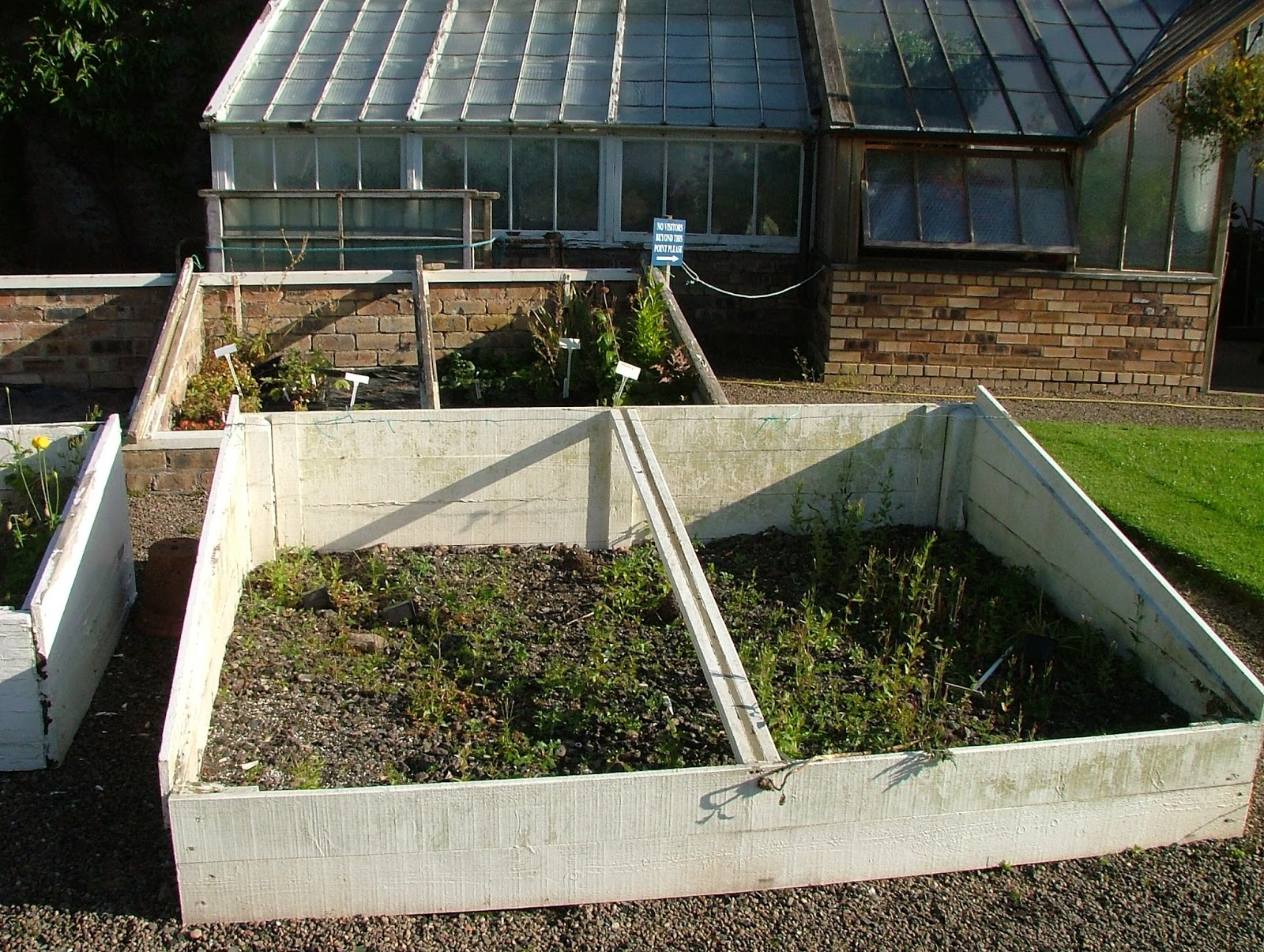
The vegetable garden was set up with one long border about five metres deep running down the length of the perimeter wall, and three large rectangular beds in the open, surrounded by connecting paths. Although there was some semblance of order in terms of crop-rotation in the main beds, it was by no means defined as I would like to see it, and the border under the wall seemed to have collected all sorts of produce that nobody had a plan for. This included a scruffy home-made fruit cage with some worn-out specimens in it, various brassicas and runner beans, and opposite this bed there was a makeshift structure designed to support sweet peas. These were a hangover from when the house had been in private hands. The previous gardener had worked the place as a private garden, and current maintenance harked back to that, even though there was now no particular need for many of the provisions that were appropriate to private service. The picture below shows how it looked -
If you know anything about me by now, after almost 100 posts, you will probably have guessed correctly, that I was about to dig the whole thing up and start again. From the next picture you will see that almost all of one of the large beds was taken up with potatoes. There are various factors at play here, not least of which, I suspect, is that the gardener had found it advantageous to grow supplies which could be stored and used throughout the winter by his own family, and I also believe that there was some impetus provided by the competitive growing environment of local vegetable shows. For these one needs an obsession, and not necessarily an eye for overall presentation. My emphasis was going to be very different. I would not need the tatties for personal use or for exhibition, but I did want to sell them in the shop and I wanted the garden to look good while we were growing them, By the way, most gardeners know that if you want to clear the ground in an overgrown garden, then potatoes are the answer. Potatoes clear the ground, isn't that what everyone tells you? More horseshit, I'm afraid. Literally. The point is, spuds are not a magic formula for getting out of working your land. The reason they help you to get rid of long-standing weed problems is the kind of cultivation they require. You have to dig deep, incorporate copious quantities of manure, and you have to earth them up into ridges to exclude light from the tubers so they don't turn green, and then you have to dig deep again to harvest them. The potatoes have done nothing to contribute to the clearance. Your digging has done it all. If you have no use for acres of edible tubers, then all you have to do is dig your ground conscientiously and you will achieve the same result. Another myth exploded. Here's the picture of how it was -
Those long, long rows stretching from one side of the beds to the other, forcing you to trample through the mud to hoe or harvest were the traditional layout for so many veggie gardens throughout the world. But how stupid do you have to be to want to work like that? I certainly didn't envisage continuing without making some changes.
The border under the wall was split into two halves by a path which led to a gate opening directly onto the road which was no longer used on safety grounds. The runner beans marked one side of the path. On the other was an unaccountable planting of Dahlias, again a throwback to the old days, when these would have been grown as cut flower for the house. They weren't even particularly attractive Dahlias, and were being grown in a mulch of weeds which made them look even worse -
It was all going to have to go to make way for something revolutionary. An entirely new concept, founded on co-operation between the two gardens, bringing them into harmony, and in so doing, giving this garden's name a significance.
The other garden, with its unique concentration on dried flowers, had borders which were really quite limited in size for harvesting the material from. Because of this, they could look stripped when a crop had been taken for drying, which lessened the amenity value of the flower borders for visitors. My thought was to grow the flowers here, in the larger garden, in this long border under the wall, and treat them as a crop, denuding them completely if necessary when the flowers were ready, and allowing the other garden to retain its colour so that visitors could enjoy it, and also so they could see how the dried flowers looked before processing. This would then leave borders for our dried flower expert to talk about with the visiting public, while still providing him with ample material to dry and sell. The space we had available was at least five metres deep, and perhaps 40 or 50 metres long, so there was a lot of room available to realise my vision. The fruit and vegetables could then be grown in the remaining three rectangular beds for display and sale. And that's what I am going to show you tomorrow.
Friday, 21 April 2017
Day 95 - Stooping
There were two aspects to the kitchen garden - firstly, the way the veggies were grown, the siting of the different areas required and their orientation, and secondly, the restoration of the box hedges that defined the areas. I probably worked on both aspects at the same time, but for the purposes of this blog, I shall start with the hedges.
This was an example of overall neglect which extended beyond the bounds of the food-growing area, as there were other low hedges in the ornamental garden, and these, too, were shapeless and ill-maintained. The hedges weren't tall, and yet, at a height of not much more than a foot from the ground, they still managed to look top-heavy and as if they were collapsing. I have no idea how anybody could achieve that. A fine example can be seen in one of the neglected borders behind the house, where the overall dereliction can be observed obscuring the rough hedges -
For some reason, because these borders were near the kitchen, I suspect, someone had decided to plant herbs in them, without much consideration for future maintenance, and they had become overrun with various varieties of mint, which contributed to the general drab jumble you can see.
Hedges elsewhere were less out of hand, but nevertheless very uneven, fluffy and rounded, undulating haphazardly along their length, and failing in their border-defining task -
It didn't actually take much to bring them back under control, although the process involved back-breaking stooping for hours at a time in the dead of winter, and the end result was quite a lot of bald sticks which needed a season to green up fully once more. I was happy with the results, which gave me something to work on for the future. That same border looked like this by the following March, complete with my new team of gardeners, who by then had not long started -
Obviously, it wasn't going to look perfect yet, as it was seriously wonky to start with. Note that by this time, I had acquired a shredder, and had also cut down the herbaceous plants and mulched thickly with chipped and shredded material. I made good use of the mountainous piles of dead branches that I had inherited from my predecessor, in the process tidying unsightly heaps of spoil ten feet high which no visitor could have failed to notice. In the kitchen garden the hedge improvements made a big contribution to the formal feel of the beds, although there were still years of work in them to make them properly straight and level -
That was still only March, though, and at a very early stage. This photo is worth keeping in mind, as it shows the very basic layout of rectangles in the kitchen garden, which were about to benefit from a serious rethink. Traditionally they had been divided up into four for crop rotation reasons, and then gardened in long rows from side to side in the traditional manner. This was about to change.
Thursday, 20 April 2017
Day 94 - Shambles
We needed gardens befitting their setting, which was very beautiful. I did what I could that first summer, but I can't remember all of it. My overriding impression was of stumbling around tripping over things and taking tea and lunch in a dark stone shed with a member of seasonal staff with some unhygienic habits, which it would be unfair to describe here. This dismal lunch routine was a hangover from the separation between the two gardens, as one team ate in a dungeon, and the others sat round a table in relative comfort 200 yards up the road. I resolved that this was one thing I would change when I established my new team. We would all be taking our breaks in a place where daylight reached.
Typically for the type of charitable organisation for which I worked, there was no money available for anything, so when it came to replacing the team there was a financially-enforced gap between the expiry of the old seasonal contracts and the commencement of regular ones for the new staff. We were going to be without help from October through to the following spring, leaving just me and our one part-time gardener to look after both sites. For this reason, I had little choice but to continue the separation of the two gardens, with me working in the larger one, and leaving the other one in the hands of my colleague. However, through the winter I made a point of taking my breaks in the more comfortable facilities up the road in the interests of learning more and building up morale. I hope it worked.
Two things concerned me through that first winter on my own in two and a half acres of run-down garden. The first was to sort out the kitchen garden, and the second was to organise the greenhouse. Not necessarily in that order. We would not be able to make any progress in either garden unless I had a working facility under glass, so I set about a big tidy up job indoors. Remember that the greenhouse was being used as a tool store and general dumping-ground? Well, also crammed into it was a scruffy tomato plantation and a poor display section, presumably meant to operate as an ornamental feature. Here are the tomatoes -
And here are the indoor displays!
Bearing in mind that we had a string across the entrance to the glasshouse and no one was supposed to enter, it was hardly worth preserving a house of ornamentals, even supposing it had been a good one, if nobody was going to see it. I resolved to make better use of the space. Some of the plants would be useful for outdoor show in the summer, however, so I didn't necessarily want to dispose of them altogether. For instance, the Aeonium on the left of the picture, I remember using as a centrepiece to an annual border the following summer. There were also some perfectly salvageable cold-frames which were almost empty, hosting only a mass of weeds. These were to be incorporated into my plans to create a proper propagating facility. Also, I could not countenance going into my next open season with the disgraceful plant sales display I had witnessed on arrival. In future, all plants would be grown here, and transported the short distance up the road to be sold in the shop, where the revenue could be properly accounted for. Our current execrable sales area could then become a standing ground for growing plants on in the open, increasing the available space for producing quality plants. Sorted. In the end the greenhouse looked like this -
Forgive the badly-stored hose - it's a work in progress. Note the potting shed at the far end, now tidied, with room for three to work side by side, albeit quite intimately. From the other direction it looked like this. Note the Aeonium, kept for posterity -
The other end of the house also found a new purpose, growing new plants for use in the garden, both ornamentals and vegetables, as well as producing plants for sale -
By the following summer, our plant sales area had gone from this shameful shambles -
to this -
The cold frames had also been cleaned up, lined with ground cover membrane and put to productive use, having had their woodwork and glass restored -
Not bad, considering a fairly inauspicious start -
How could anybody have considered opening to the public like that? Well they did, but no more. Not on my watch.
Wednesday, 19 April 2017
Day 93 - A cupboard for the boss
I arrived at this new job in summer, in July. It meant I had the best part of three months with the existing team before I could make any changes to set up a permanent base of staff to push forward the restoration. How was I going to cope? It all looked wrong, and I almost felt embarrassment to step across the road and look at the place I had inherited. The tools and equipment were poorly maintained, the greenhouse and potting shed were in a shambolic state of untidiness, as I have already shown you. The machine store was impenetrable through piles of junk. And the garden was a public disgrace. I thought back to my previous job and wondered what I had inflicted on myself. Then I remembered that it had looked just as uncared-for when I arrived there too.
So I sat back, disciplined myself, and observed. I talked to people. I put forward ideas, and sensed some reluctance, some muted agreement. I tried not to be negative about the status quo. Nobody lets their garden degenerate like this without a reason. It may be shattered morale, or it may be incompetence or lack of vision. There were elements of all three which became apparent. Fortunately, the permanent core of staff did not come under the incompetence category. It was a morale issue, and low morale infected all levels, including the seasonal workers. I had to look for positives in the long term.
In the short term, I had lots of things to familiarise myself with. I had to get to know the volunteers for a start.
The larger garden had only three. One retired bloke who was an absolute joy, who walked across the footbridge over the river from the village on the other side to come to work, helping with the mowing, and two characters with learning disabilities, who were also a real pleasure. One of them liked to come in and turn the compost every week, and the other, although more wayward, was a proper sweetie underneath. He brought me back a cheap plastic clock from his holidays once, which sits on my bookshelves still, keeping perfect time, twelve years later.
The other garden had a dozen or so, one of whom was the ex-nurseryman and fruit grower I have already mentioned, and the rest of whom were ladies involved in the processing of dried flowers, for which we had a purpose-built drying room and workspace at the back of the shop. They were all good people, although, as is typical, most of them had axes to grind. Volunteers generally want the best for the establishments they support, and struggle when they see it failing. The default mechanism is to come up with solutions which suit their personal foibles, so as a manager I often found myself faced with a variety of different approaches requiring appeasement, before implementing the solutions which I deemed necessary after thorough observation.
Not only that, but I also had to learn a little about the retail side of the business, which was run in a dynamic but quite bizarre way by a department manager who would be responsible to me. This proved exhausting. In addition, the shop manager was very glad that I had arrived in one way at least - it would now be possible to dump the administrative chaos upstairs onto my desk, where I was expected to flounder.
For this reason, I was sometimes to be found stuck in my office and away from the gardens, letting them continue in their own way in my absence, while I sorted years of administrative backlog. My office was in a cupboard in the centre of the shop. This was fitted with a small Velux window, had no view and was stifling and headache-inducing. Here I had to get to grips with the weekly accounting, which was performed using the most convoluted computer program ever devised, and took me ten times a long as it would have taken Bob Cratchit in exquisite copperplate longhand. On the door of my office, I placed a sign labelling it, laughably, 'Manager's Office' and appended the following drawing above it -
Fair comment, I should say.
Meanwhile, I fiddled about in the gardens, keeping a watching brief, and undertaking tasks which I could see no one else was going to bother with. As usual, I gave particular attention to the climbers, of which there were a number which were out of control. I was very pleased also to find a couple of fan-trained apricots in the larger garden which needed a lot of work -
The netting, obviously, was there to keep the birds from the blossoms and fruit, but in fact had never been attended to, and the tree itself had grown through it. I had to cut the netting out first before being able to prune and retie the Apricot. When finished, it looked a picture. Typically, that is not really a picture I have. You'll have to make do with this, where the bare tree can be seen against the far wall, minus netting, its shape still largely dictated by the previous umpteen years of not being treated properly -
Also behind the scenes I was able to start gradually tidying up the greenhouse and potting shed, and thinking about what to do with the mower store at the end of the complex of buildings, which so far was all but impenetrable. This would eventually become my tool store, where all hand tools would be neatly racked on the walls, and the mowers stored in the central space. The shelving would be reorganised and used as essential storage for sundry pieces of equipment and consumables -
For now it was just a mess. But it gets better, you'll be pleased to know. as usual I have no photographs to show you of how that particular space was revolutionised by organisation, but I cannot stress how important it is in terms of efficiency and morale to have a tidy workshop, where equipment can be maintained, and most especially, found, when required. And we always put tools away cleaned and oiled every day, once I gained full control of the situation. That meant first ridding the place of some very dirty habits, and allowing some recalcitrant staff to go their own way on the expiry of their contracts.
Tuesday, 18 April 2017
Day 92 - Home wreckers
We arrived in time to give us a weekend to settle in to the house before starting work. Unfortunately, it was the one weekend in the year when the house opposite, for which my job carried the responsibility, hosted its only wedding of the year. We didn't sleep a wink.
The house was an attractive holiday let which slept twelve, and I had assumed that people would use it as a base for walking holidays or some such, and would arrive in groups which would spend most of their days out in the hills. How naïve I was. In fact, it turned out that its most frequent use was as a party venue for people who preferred to wreck somebody else's house rather than their own. For my entire time there it caused me grief, especially so as its front gate was literally 20 metres from my house and I couldn't avoid any of the shenanigans. Nor could I escape the imposition of unsolicited callers at my door expecting me to fix things on a Sunday which they had destroyed on the Saturday night. And they used to pinch fruit and vegetables from the garden which I had earmarked for sale. The house itself was an attractive place, however, and of course was the reason for the garden, so I suppose I ought to have been more grateful.
It had a certain symmetry, a balance, a harmony, from which it derived its name. Inside was a fine staircase with some rickety banisters -
Anyway, I decided to put my head down and ride through the storms brought by the holiday let, and hope that the gardens brought sufficient rewards to compensate.
The fact is, both gardens looked a little domestic compared to the one I had been working in, and at first it felt like a huge come-down after what I had been used to. It took a while to discover that in fact there was much here for me to learn. The smaller garden, for example, was the only dedicated dried flower garden in the land, and I knew nothing about the processes involved at all. It also had an orchard of historic apple varieties and various other top fruits, a discipline in which, again, I lacked experience. I found the lack of experience an advantage as usual, as it gave me no fear of flouting convention. I did have the benefit of the advice of an elderly volunteer who had worked in the field all his life, and I valued his experience. Nevertheless, I was in a hurry, and had the temerity to ignore his instructions on a gradual phasing of the remedial pruning which was so desperately needed, in favour of quite rigorous measures in the first years. He muttered behind the scenes in disapproval, but it worked. Remember, when you are pruning fruit, that winter pruning stimulates growth, and that is the reason you always hear warnings about the forest of so-called water-shoots that such intervention will produce. Everyone is afraid of these, as if a vigorous response is a bad thing, when in fact what your tired old plants really need is that shot in the arm. The problem is that most people don't get round to the summer pruning that needs to follow. Summer pruning restricts growth. You need to combine the two. Of course, if you have the time to phase your winter pruning, that can be an advantage, but I never had time. I was always thrusting on, making up seconds and minutes for the next task.
Furthermore, the larger property had a sizeable kitchen garden, and again this was a field in which I had no professional experience and could have fallen on my face. No matter. I had by now over twenty years previous as a gardener, most of it as the man in charge, and my confidence was at an all-time high. The veggies I could cope with on my own if necessary, of that I was sure. I knew how to do it. I just didn't have experience on this scale. And I found from conversations over tea and lunch breaks, that our part-time gardener was in fact very knowledgeable on the drying processes and the historic fruit varieties. There were areas he would supervise better than I could. In this way I hoped to return self-respect to the gardens. My job would be to oversee the two sites to unify them. We were going to make this work, by pooling expertise and employing personnel to make the best of their strengths. And all the while, I would be learning. That is enough to make a person feel young again. And it worked for a while.
Monday, 17 April 2017
Day 91 - Nice house
There is an advantage in being known in your trade for the kind of work you do, assuming your reputation is a good one. I was able to walk out of one job and straight into another. The world of historic gardens is quite a small one, and I knew the Gardens Adviser in the new job. The interview, as I remember it, was fairly straightforward. I would be taking on two small town gardens, amounting to five and a bit acres in all, or was it nearly seven? Can't remember. Anyway less than I was used to. The town was very picturesque, set near the river, the abbey and some distinguishing hill formations. The gardens, on the other hand, needed a lot of work, and struck me, coming from a place that was by now nearly fully restored, as being seriously disgraceful. Just my sort of project, then. I was also told that there were underlying staff morale problems, possibly warring factions, and reading between the lines, the higher management left a lot to be desired too. I wasn't in a position to be wary about this, however, and having seen how beautiful the surroundings were, I sent for my partner, later to become my wife, to have a look at the place. She flew up and was immediately taken by the situation, so we decided to go for it. She had the chance of two jobs with the same company, one in the South of England, and one in Scotland, so she made her choice and we moved.
I gradually found out the nature of the problems I would have to work on. First of all, there was no team to speak of. There were only two permanent members of staff, one of whom ran the retail side of the business, and the other of whom was part-time in the garden, and each of those had at one time or another been the other's boss, which does not make for harmony. Other than that there were a couple of seasonal gardeners with little spark, and the two gardens had a history of malicious separation from one another, whereby the twain never met. It fell upon me to resolve all this. The first thing I would have to do was see the summer season to its conclusion with its contingent of temporary staff, observe what was wrong with it, and then set up a new team for the start of the next year.
God, it was hideous. One of the gardens, the smaller one, was limping on in the doldrums it had found itself in, with its garden and retail sections largely avoiding each other, and the other garden was in the hands of an uncommitted seasonal member of staff with no eye for presentation and limited enthusiasm. It was also subject to constant interference from the previous gardener, whose leaving had created the vacancy for a new type of management that I was supposed to provide. It was the intention that the two gardens would not only be restored and improved, but brought together as one functioning unit. At any rate, that was the only way I could see it working. But in the meantime, I had to get everybody to accept me first, then build a team, then fix the horticulture, which was weird, to say the least.
I'm going to show you a nice picture first, of the house I was given to live in, so as not to put you off with a rough old image of the garden in disarray -
It was a very beautiful house, with enormous rooms, formed from an old stable block, so it had good connected stone outbuildings and was attached to a 2.7 acre orchard on which I used to run our chickens, but which I maintained in works time as part of my job. Ideal! The rose needed severe sorting out, by the way, before it looked like that. Here is a winter scene -
This was my initial pruning. I intended to improve on that framework in time.
As for the state of the gardens, if I tell you that this was the plant sales area when I arrived, you will probably see what I mean -
As you could never find the member of staff who was supposed to be looking after this, the larger of the two gardens, plants and vegetables were being sold on an honesty basis, although, to tell the truth, there wasn't a lot worth buying. I immediately saw an opportunity here. After all, we had a shop up the road attached to the other garden. It doesn't take a genius to see that that could bring benefits. But not when a defensive stance was being taken, with no cross-fertilisation between teams. I knew what I had to do. First, though, I had to get a product that people would want to buy. And that wasn't going to come from a potting shed like this -
or a greenhouse like this -
or a vegetable garden like this -
Ok. They were growing veg, but there were weeds in the beds, weeds in the path, the hedges were badly maintained, stakes were lying about, there was a permanent trip hazard in the form of a hose and there was vegetable debris, including potato haulms, or shaws as they are called in those parts, all over the place -
We'd have to see what I could do about that.
Sunday, 16 April 2017
Day 90a - Feelthy Peectures Addendum
For those of you who have not accessed this blog on twitter, I received the following photograph as a comment from the father of three of my grandchildren, with the caption 'Some Orchis italica for your Russian and French fans!' Thought you might like it too -
Day 90 - Feelthy peectures?
I sort of half-promised you that I would tell you about the next stage of my career, and the progress of my next job with all its startling revelations about the world of professional horticulture. I make a lot of promises, and I try to keep them, but I'm not always as prompt in carrying them out as I pretend. On this occasion, I am going to take a breather while I contemplate the futility of trying to do what I am attempting.
I have to admit, my readership has dropped off dramatically. I have taken soundings on this. It seems that it is too much of an obligation to have to read a post every day, even if it is interesting and informative. In a way I get that, but then I ask, how much time do we spend sitting on the toilet, trying to decipher what it says in tiny writing on the back of the shampoo bottle that is there just out of reach on the wash-basin? How much time do we spend flicking through our facebook timeline or twitter feed, reading fragments as fast as we can, just so we can decide to ignore them as irrelevant junk that is the price of having friends or followers?
1000 words of my wisdom, accompanied by pretty pictures has to be better than that. Yet still my diagnostics tell me that my readership is plummeting. I find that the majority of my readers come from the United Kingdom (I question the word United in these days of turmoil), then a large contingent from France, vying for second place with my American followers. I investigate the reason for my strong French support, and find that none of them is reading my blog at all, and that somehow all my French interest comes from referrals from various dodgy sites and the furtive search for pornographic images. How they end up on a gardening blog beats me. Bonjour Messieurs. Feelthy peectures? I have images of manure, sexual reproduction in plants, and yesterday a highly phallic Dracunculus. Did you get off on that?
Actually, it's really pissing me off. The last time I wrote a daily saga on my blog, when I compiled my memoir of a broken man, hundreds of my hits came from Russian porn addicts. This time they are French. Same difference. They're not looking for what I am writing about. And I am not prepared to give them what they want. So why don't they leave me alone. Mine is a different kind of fantasy.
I fantasise about people reading what I write. But that's a step too far. I'm not going to find that on the internet. Or in a publisher's office. I need to look for something else. No matter that my wife encourages me in this gardening thing, tells me that it is interesting. 1000 words a day is too much for our quick-fix culture. Not when people would rather be sitting in front of their screens with no trousers on playing with their Transformers. Forgive the smutty analogy. I've tried the gardening, but it seems I'm better suited to lewdness. My French readers have obviously caught up on that.
Anyway, sorry to disappoint you, my readers across the channel, this is a blog about plants and gardens. This is not for you. This is for the genteel, not for sex-obsessed onanists leering at their screens in self-imposed solitary confinement. This is a blog your mum could read. So here's a nice picture of a plant.
This one is Rhodochiton atrosanguineum. An attractive little climber. For the benefit of my French readers, it is commonly known as the Horse's Dick plant. Not one to send as a Mothers' Day present.
Enough of this. Tomorrow I will get serious. I promise.
Saturday, 15 April 2017
Day 89 - Whiffy
I'm not going to dwell nostalgically on too many plants, although I thought I might originally. I did go through a few obsessions though. For a while I had a thing for foxgloves, especially the perennial ones, although we had plenty of the common ones dotting themselves around too. In my time I grew Digitalis lanata, D. ferruginea, D. ambigua and D. obscura, which was so obscure nobody noticed it except me, and various others besides. D. ferruginea was always a strong performer, reaching shoulder-height with its yellow, brown-tinged narrow flowers and forming large clumps. Others did less well and needed constant replenishing with young seedlings which we grew in the greenhouse, such as D. lanata, which was predominately white with brown markings and a pronounced lip at the base of the trumpet. Can't remember which one this is, and it is not a particularly clear photograph, but it's a fine thing anyway -
In some ways, though, you can't beat the common wild arrivals, which do sow themselves in nice informal drifts if you can bear to leave them there -
I could go on at length about individual plants, but I'm going to rein in my natural volubility and restrict myself. Perhaps I'll get back the readers who have deserted me if I am more concise? Nevertheless, I might just mention that we had a fine collection of Viburnums. These included the ubiquitous V. plicatum 'Mariesii' with its tiers of lacecap flowers which are so popular. Much better was the variety V plicatum 'Pink Beauty', which the Old Man obtained by accident when Hilliers Nursery phoned him up and said, 'We've got a Viburnum we can't get rid of, would you like it? to which he answered 'Yes'. It has the advantage that it is much more compact and the white flowers age to pink over a period of 6-8 weeks, followed by the berries. Plant that next to a Hydrangea paniculata type to flower later with a similar colour shift, and you will have flowers for more than quarter of the year for no more outlay than the price of a couple of shrubs.
On the terrace we had a Viburnum which was listed as V. juddii in our plant catalogue. I'm not sure that it was, as it differs significantly from the other specimens of V. juddii I have seen. In fact this one was far better, with handsome strong pink buds opening to white, and giving off a glorious powerful perfume right in front of one of our benches, which was rarely without a guest when these were in flower -
Other similar varieties dotted around included Viburnum carlesii and its hybrids. These were similarly highly scented, but lacked the attraction of the deep pink buds which gave this one its character. They were still a sensory delight to insert your nose into though -
I found very early on that it was a good idea to place scented flowers near the benches, and encouraged this as much as I could. On other occasions, I had to have my little joke. One plant I had discovered when looking over a hedge into the butler's garden while cutting the top, was a spectacular tuberous individual of the Arum lily family, with enormous dark spathes which were visually spectacular. I could see that the butler's garden never received attention, and when there was a change of personnel within the house, I took the opportunity to nip in and lift all the plants, which in any case had belonged to the property my organisation had inherited and were in danger of being lost through the neglect of the private staff in whose garden they now found themselves. Presumably they had been placed there originally because they are not reliably hardy, and needed a sheltered spot in the lee of a hedge.
Once I had got my grubby hands on them, I sought a sheltered enough spot for them, and decided that they would be best suited to a prominent position under the south wall of the mansion, which although susceptible to strong winds, was nevertheless quite warm, especially as the occupants had the central heating ramped up to choking levels all winter. It was only later when we added in some extra benches carefully spaced along the terrace that I realised that I had placed the foul-stinking Dracunculus vulgaris right behind one of the seats, which remained conspicuously empty for a couple of weeks while the clump gave off its insect-attracting stench of rotten meat. Even gardeners have to have fun, and I never moved it -
Never mind the smell - those are a foot long and more!
So that's it. No more from this garden. My wife had left me a couple of years before, my kids were grown up and had left with her, favouring the town with its pubs over the simple country life in a place where the public transport shut down at 6.00 in the evening. But it had been a great place with considerable freedom for them to grow up in. It was time for new directions.
As for me, I had started a new relationship, and needed a fresh angle on life. We were both lucky enough to find employment back north of the border at the same time, and fresh beginnings beckoned. See you later with fresh challenges.
But I can't say I wouldn't miss my lovely garden, the place where all my ideas formed and the high-point of my career -
Look at all that colour in the season of mists and mellow fruitfulness. Can't fault it, and it takes me right back to day 1 of this blog, when I mentioned the subtle charms of Abelia chinensis, with its lack of ostentation and throwaway scent which surprises every time you walk past it. It's just out of the picture to the left. Tantalising, huh?
Subscribe to:
Posts (Atom)